Tuesday, June 19, 2018

China Vows to Retaliate as Trump Targets $200 Billion in Tariffs

LISTEN TO ARTICLE 5:10 SHARE THIS ARTICLE Facebook Twitter LinkedIn Email

Trade tensions between the world’s two biggest economies intensified, with China vowing to retaliate "forcefully" against President Donald Trump’s threatened tariffs on another $200 billion in Chinese imports.

"If the U.S. loses its senses and publishes such a list, China will have to take comprehensive quantitative and qualitative measures," according to a statement from the Ministry of Commerce. It labeled the move "extreme pressure and blackmail," and said it would retaliate with counter measures.

Trump ordered up identification of $200 billion in Chinese imports for additional tariffs of 10 percent -- with another $200 billion after that if Beijing retaliates. While the $50 billion in tariffs already announced on Friday were mainly on industrial goods, the broader move would push up prices for toys, tools, t-shirts and a lot more for U.S. shoppers.

Markets soured as economists warned of damaged business confidence, a blow to China’s growth prospects and ripple effects through its supply chains. The benchmark index of Chinese stocks fell almost 4 percent, other Asian share markets declined and U.S. equity futures traded lower, while safe havens including the yen, gold and Treasuries climbed.

"Its psychological effects, its effects in increasing uncertainty, could be very serious and we’re certainly getting later in a cycle of escalation," former U.S. Treasury Secretary Lawrence Summers said in an interview on Bloomberg Television.

For More on the Trade Dispute:
The White House says the U.S. can withstand trade tensionsSee how American businesses are girding for new tariffsTrade war’s coming for your hip pocket AmericaThe IMF says the global outlook is worse as tensions riseHere’s what a full-blown global trade war might look likeWhat economists say about Trump’s new trade threatsTrumps Tariffs spread pain to non-Chinese companies

By targeting goods that are finished in China but whose components are often sourced from neighboring South Korea, Japan and Taiwan and more, the U.S. strategy could hurt the economies of America’s allies too.

"The collateral damage from an escalating U.S.-China trade war will be widespread, hitting many Asian countries that are part of China’s manufacturing supply chain in sectors such as electrical and electronic products," said Rajiv Biswas, Asia Pacific chief economist at IHS Markit in Singapore.

There are dangers for the U.S. economy too. If implemented, the tariffs would mean a sizable amount of imported Chinese goods would be exposed to new tariffs. Higher prices on imported goods could dampen consumer sentiment and pressure inflation.

"In a global trade war, no matter how you spin tariffs, retailers and the American families that we serve are the losers," said Hun Quach, vice president, international trade, for the Retail Industry Leaders Association.

Tom Orlik, chief economist at Bloomberg Economics, said that in the event that China’s exports to the U.S. weaken in the face of tariffs, the government would likely seek to offset the growth impact with a combination of subsidies to support domestic demand and higher infrastructure investment.

The People’s Bank of China is using both money and words to try to ease market concerns about escalating trade tensions and the weakening economy. It injected another 200 billion yuan ($31 billion) into the economy via its medium-term lending facility on Tuesday, pushing its net injections so far in June to the most in any month since December 2016.

The escalation in trade tensions comes at an inopportune time for China’s policy makers, with indicators for May suggesting growth is already dialing back a notch.

#lazy-img-328575708:before{padding-top:56.25%;}

The U.S. President last week threatened 25 percent tariffs on $50 billion in Chinese products and said at the time he would impose even more duties if China retaliated. A counter punch was swift in coming, with a statement from Beijing on Friday night that it would "strike back forcefully."

China’s threat “clearly indicates its determination to keep the United States at a permanent and unfair disadvantage,” Trump said Monday. “This is unacceptable. Further action must be taken to encourage China to change its unfair practices, open its market to United States goods, and accept a more balanced trade relationship.”

The latest salvo came as Trump seeks to convince U.S. lawmakers to let Chinese telecom company ZTE Corp. remain in business after it became a bargaining chip in the trade row. Earlier this month, the Trump administration gave ZTE a reprieve for breaking a sanctions settlement after the company agreed to pay fines, change management and agree to American oversight. ZTE’s survival has been a key goal of Chinese President Xi Jinping.

Shares in ZTE dived after the Senate passed legislation on Monday evening that would restore penalties.

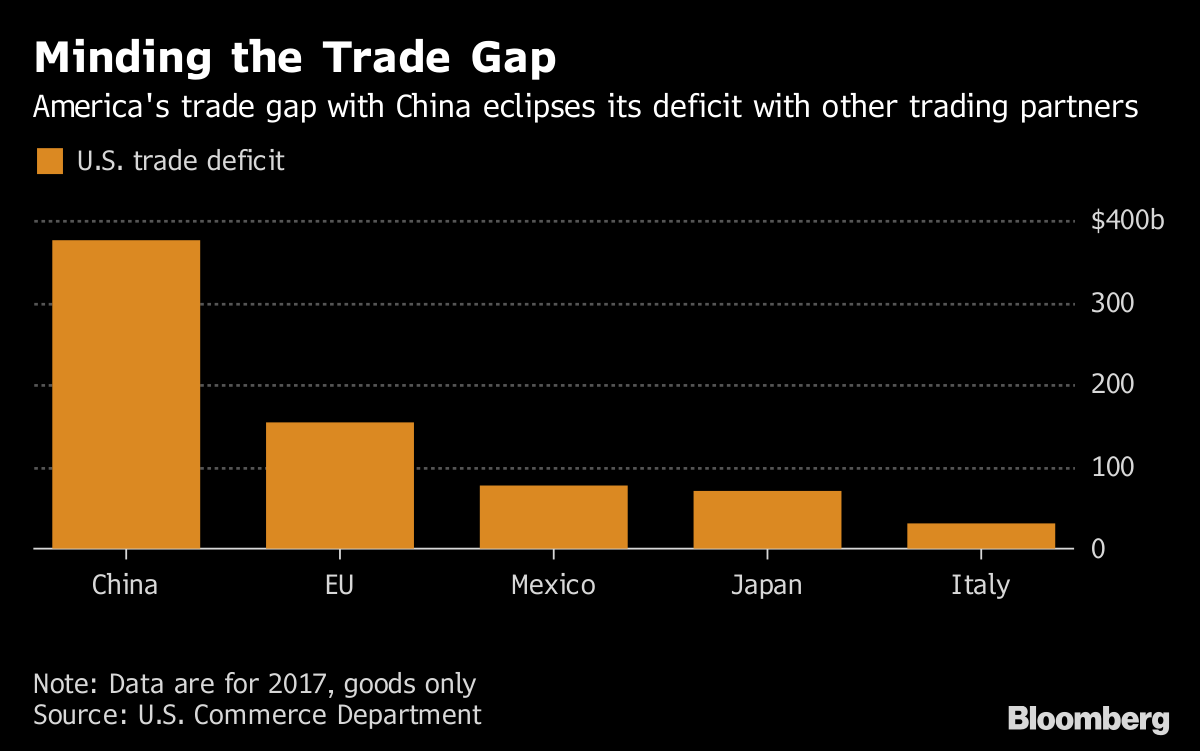
The U.S. imported $505 billion of goods from China last year and exported about $130 billion, leaving a 2017 trade deficit of $376 billion, according to U.S. government figures. The fact that America imports more from China will make it harder for Beijing to match Trump’s attacks, according to Derek Scissors, a resident scholar at the conservative American Enterprise Institute in Washington who focuses on China.

Minding the Trade Gap

America's trade gap with China eclipses its deficit with other trading partners

Source: U.S. Commerce Department

Note: Data are for 2017, goods only

.chart-js { display: none; }
“All they can do is impose higher tariffs on a smaller subset of products,” he said. That being said, “China is going to retaliate,” he added.

— With assistance by Kevin Hamlin

(Updates with comment from former U.S. Treasury Secretary Lawrence Summers. An earlier version of this story was corrected to remove an incorrect reference to tariffs on agricultural products.)

Monday, June 18, 2018

Intercontinental Exchange Inc (ICE) Given Average Recommendation of “Buy” by Analysts

Shares of Intercontinental Exchange Inc (NYSE:ICE) have been assigned a consensus recommendation of “Buy” from the sixteen brokerages that are covering the stock, Marketbeat.com reports. One equities research analyst has rated the stock with a sell rating, four have assigned a hold rating and eleven have issued a buy rating on the company. The average 12 month price objective among brokerages that have updated their coverage on the stock in the last year is $78.31.

ICE has been the subject of several research reports. Zacks Investment Research lowered shares of Intercontinental Exchange from a “hold” rating to a “sell” rating in a research report on Tuesday, June 12th. ValuEngine raised shares of Intercontinental Exchange from a “hold” rating to a “buy” rating in a research report on Monday, April 2nd. JPMorgan Chase & Co. raised shares of Intercontinental Exchange from a “neutral” rating to an “overweight” rating and increased their target price for the stock from $76.00 to $83.00 in a report on Tuesday, February 20th. Deutsche Bank increased their target price on shares of Intercontinental Exchange from $80.00 to $81.00 and gave the stock a “buy” rating in a report on Friday, April 6th. Finally, Sanford C. Bernstein began coverage on shares of Intercontinental Exchange in a report on Monday, April 9th. They issued an “outperform” rating and a $85.00 target price for the company.

Get Intercontinental Exchange alerts:

Shares of Intercontinental Exchange traded down $0.16, hitting $74.36, during midday trading on Tuesday, according to Marketbeat.com. 4,074,586 shares of the company’s stock traded hands, compared to its average volume of 2,265,249. Intercontinental Exchange has a 1 year low of $63.22 and a 1 year high of $76.69. The firm has a market capitalization of $43.07 billion, a P/E ratio of 25.21, a PEG ratio of 2.03 and a beta of 0.62. The company has a quick ratio of 0.98, a current ratio of 0.98 and a debt-to-equity ratio of 0.25.

Intercontinental Exchange (NYSE:ICE) last released its quarterly earnings results on Thursday, May 3rd. The financial services provider reported $0.90 EPS for the quarter, beating the Thomson Reuters’ consensus estimate of $0.88 by $0.02. Intercontinental Exchange had a net margin of 41.65% and a return on equity of 11.14%. The firm had revenue of $1.23 billion during the quarter, compared to analyst estimates of $1.22 billion. During the same quarter in the prior year, the firm earned $0.74 EPS. The business’s revenue for the quarter was up 5.1% compared to the same quarter last year. equities research analysts anticipate that Intercontinental Exchange will post 3.52 EPS for the current year.

In other Intercontinental Exchange news, Vice Chairman Charles A. Vice sold 35,000 shares of the company’s stock in a transaction that occurred on Wednesday, June 6th. The stock was sold at an average price of $75.65, for a total value of $2,647,750.00. Following the completion of the transaction, the insider now directly owns 417,507 shares in the company, valued at approximately $31,584,404.55. The transaction was disclosed in a filing with the Securities & Exchange Commission, which is available at the SEC website. Also, Vice Chairman Charles A. Vice sold 50,000 shares of the company’s stock in a transaction that occurred on Wednesday, April 4th. The stock was sold at an average price of $71.97, for a total value of $3,598,500.00. Following the completion of the transaction, the insider now owns 432,507 shares of the company’s stock, valued at $31,127,528.79. The disclosure for this sale can be found here. Insiders sold a total of 273,116 shares of company stock valued at $19,591,954 over the last three months. 1.50% of the stock is currently owned by insiders.

Hedge funds have recently bought and sold shares of the business. Pinnacle Wealth Planning Services Inc. bought a new position in Intercontinental Exchange in the 4th quarter worth approximately $109,000. Valeo Financial Advisors LLC boosted its stake in Intercontinental Exchange by 257.6% in the 4th quarter. Valeo Financial Advisors LLC now owns 1,627 shares of the financial services provider’s stock worth $115,000 after purchasing an additional 1,172 shares during the period. SeaCrest Wealth Management LLC bought a new position in shares of Intercontinental Exchange during the 4th quarter valued at approximately $122,000. Bedel Financial Consulting Inc. bought a new position in shares of Intercontinental Exchange during the 1st quarter valued at approximately $127,000. Finally, Institutional & Family Asset Management LLC bought a new position in shares of Intercontinental Exchange during the 1st quarter valued at approximately $128,000. Institutional investors and hedge funds own 89.03% of the company’s stock.

About Intercontinental Exchange

Intercontinental Exchange, Inc operates regulated exchanges, clearing houses, and listings venues for financial and commodity markets in the United States, the United Kingdom, Continental Europe, Asia, Israel, and Canada. It operates through two segments, Trading and Clearing; and Data and Listings. The company operates marketplaces for listing, trading, and clearing an array of derivatives and securities contracts across various asset classes, including energy and agricultural commodities, interest rates, equities, equity and credit derivatives, exchange traded funds, bonds, and currencies.

Analyst Recommendations for Intercontinental Exchange (NYSE:ICE)

Saturday, June 2, 2018

Cree, Inc. (CREE) Expected to Announce Quarterly Sales of $401.60 Million

Wall Street analysts forecast that Cree, Inc. (NASDAQ:CREE) will post sales of $401.60 million for the current quarter, Zacks reports. Five analysts have made estimates for Cree’s earnings, with the lowest sales estimate coming in at $399.87 million and the highest estimate coming in at $405.00 million. Cree reported sales of $358.94 million in the same quarter last year, which would suggest a positive year over year growth rate of 11.9%. The firm is expected to issue its next earnings report on Tuesday, August 28th.

On average, analysts expect that Cree will report full-year sales of $1.49 billion for the current year, with estimates ranging from $1.48 billion to $1.49 billion. For the next financial year, analysts forecast that the firm will report sales of $1.66 billion per share, with estimates ranging from $1.61 billion to $1.73 billion. Zacks’ sales averages are an average based on a survey of sell-side research analysts that follow Cree.

Get Cree alerts:

Cree (NASDAQ:CREE) last issued its earnings results on Tuesday, April 24th. The LED producer reported $0.04 EPS for the quarter, topping the consensus estimate of $0.01 by $0.03. The company had revenue of $355.96 million for the quarter, compared to analyst estimates of $347.38 million. Cree had a negative net margin of 17.50% and a negative return on equity of 1.10%. The business’s revenue was up 4.2% on a year-over-year basis. During the same period in the previous year, the firm earned $0.01 EPS.

Several equities research analysts recently commented on CREE shares. BidaskClub upgraded shares of Cree from a “buy” rating to a “strong-buy” rating in a research report on Tuesday, May 8th. ValuEngine lowered shares of Cree from a “buy” rating to a “hold” rating in a research report on Tuesday, May 1st. Zacks Investment Research upgraded shares of Cree from a “hold” rating to a “buy” rating and set a $43.00 price objective on the stock in a research report on Monday, April 30th. CIBC upgraded shares of Cree from a “market perform” rating to an “outperform” rating in a research report on Wednesday, April 25th. Finally, SunTrust Banks boosted their price objective on shares of Cree from $39.36 to $53.00 and gave the stock a “market perform” rating in a research report on Wednesday, April 25th. Three investment analysts have rated the stock with a sell rating, twelve have assigned a hold rating, five have assigned a buy rating and one has assigned a strong buy rating to the company. The company has a consensus rating of “Hold” and an average target price of $37.20.

In related news, insider Michael E. Mcdevitt sold 7,000 shares of the business’s stock in a transaction dated Thursday, April 26th. The shares were sold at an average price of $39.36, for a total value of $275,520.00. Following the completion of the transaction, the insider now owns 169,924 shares of the company’s stock, valued at approximately $6,688,208.64. The sale was disclosed in a filing with the Securities & Exchange Commission, which is available at the SEC website. Insiders own 1.10% of the company’s stock.

A number of hedge funds have recently made changes to their positions in the stock. BlackRock Inc. raised its stake in Cree by 2.2% in the 1st quarter. BlackRock Inc. now owns 11,101,297 shares of the LED producer’s stock valued at $447,493,000 after purchasing an additional 239,933 shares during the last quarter. Iridian Asset Management LLC CT increased its stake in shares of Cree by 113.3% during the 1st quarter. Iridian Asset Management LLC CT now owns 3,061,229 shares of the LED producer’s stock valued at $123,398,000 after acquiring an additional 1,625,772 shares during the last quarter. OppenheimerFunds Inc. increased its stake in shares of Cree by 36.7% during the 1st quarter. OppenheimerFunds Inc. now owns 2,574,663 shares of the LED producer’s stock valued at $103,785,000 after acquiring an additional 691,708 shares during the last quarter. Criterion Capital Management LLC increased its stake in shares of Cree by 30.6% during the 1st quarter. Criterion Capital Management LLC now owns 1,758,262 shares of the LED producer’s stock valued at $70,876,000 after acquiring an additional 412,010 shares during the last quarter. Finally, Northern Trust Corp increased its stake in shares of Cree by 1.2% during the 1st quarter. Northern Trust Corp now owns 1,431,299 shares of the LED producer’s stock valued at $57,696,000 after acquiring an additional 17,209 shares during the last quarter. 98.94% of the stock is owned by hedge funds and other institutional investors.

Shares of Cree traded up $0.70, hitting $47.32, during trading on Friday, according to Marketbeat. 773,900 shares of the company were exchanged, compared to its average volume of 1,406,979. The firm has a market capitalization of $4.75 billion, a P/E ratio of 249.05 and a beta of 0.62. Cree has a 1 year low of $20.50 and a 1 year high of $48.00. The company has a debt-to-equity ratio of 0.15, a quick ratio of 2.46 and a current ratio of 3.74.

Cree Company Profile

Cree, Inc provides lighting-class light emitting diode (LED), lighting, and semiconductor products for power and radio-frequency (RF) applications in the United States, China, Europe, South Korea, Japan, Malaysia, Taiwan, and internationally. Its Lighting Products segment offers LED lighting systems and bulbs for use in settings, such as office and retail space, restaurants and hospitality, schools and universities, manufacturing, healthcare, airports, municipal, residential, street lighting and parking structures, and other applications.

Get a free copy of the Zacks research report on Cree (CREE)

For more information about research offerings from Zacks Investment Research, visit Zacks.com